


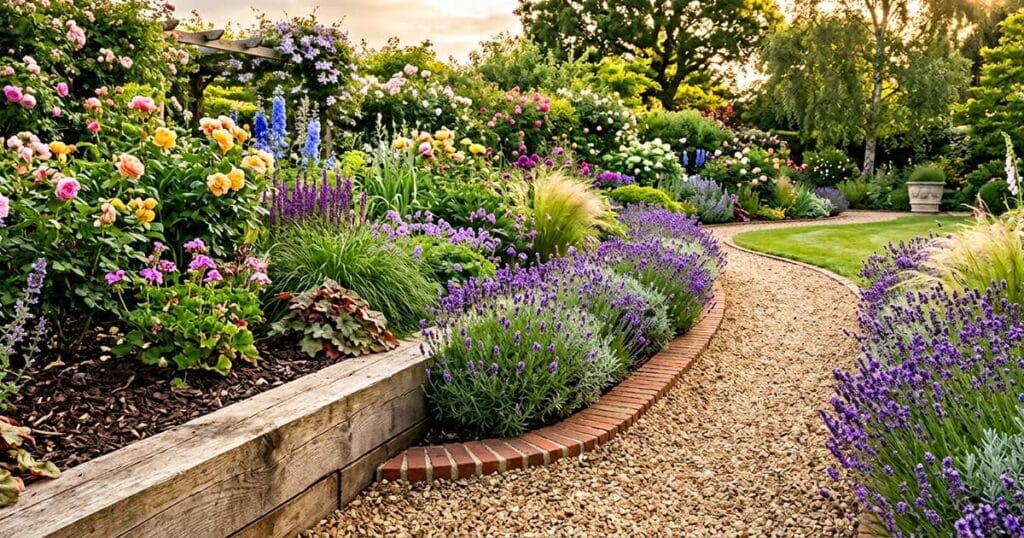
Every landscaper knows the secret, and it costs less than a pizza: crisp edges make gardens look finished. The difference between “nice plants” and “wow, what a garden” is usually just one clean line between bed and lawn.
The best garden edging ideas do triple duty — stopping grass creep, holding mulch in place, and framing your beds like a picture. And unlike most garden upgrades, edging rewards a single weekend’s work for years.
The ten garden edging ideas below run from free-and-instant to worth-every-penny permanent, and each lists the difficulty, budget, and key elements. Finishing new beds from our raised garden bed ideas guide? Most of these edges pair beautifully with them. Time to draw some lines!
1. The Classic Spade-Cut Edge
The oldest edge in the book is also free: a clean V-shaped trench cut straight into the soil with a flat spade or half-moon edger. Slice a 4-inch-deep cut along the bed line, angle the bed side at 45 degrees, and toss the turf strips into the compost. Grass roots hit the air gap and stop.
The look is quintessentially English-garden — invisible infrastructure that lets plants steal the show. Redefine it once a year in spring and touch up with shears monthly, and it stays sharper than any plastic strip ever will. Cut it in cool light if you can — low raking sun exposes every wobble in the line.
Among all garden edging ideas, this is the zero-budget classic the pros still reach for first.
- Difficulty: Easy, one satisfying afternoon
- Budget: Free — just elbow grease
- Key elements: Flat spade or half-moon edger, string line for guide, garden shears for maintenance


Alt text: “Spade-cut trench edge, the free classic garden edging idea.”
2. Wooden Plank or Sleeper Edging
Timber edging is the woodworker’s home turf, and it suits everything from cottage gardens to modern layouts. Set 2×6 cedar or oak sleepers vertically for a chunky contemporary band, or run them horizontally with hidden stakes for a raised border.
Cedar and oak shrug off rot; skip old railroad ties near edibles. The craft details make it: level the first board religiously, slant-cut the tops to shed water, and pre-drill every stake hole.
Done well, timber edging outlasts the beds it guards and ages to handsome silver — proof that the simplest garden edging ideas often outlast the fancy ones.
- Difficulty: Easy to moderate DIY
- Budget: $2–$6 per linear foot
- Key elements: Cedar boards or oak sleepers, wooden stakes, exterior screws, level, string line

Alt text: “Wooden plank edging, a DIY-friendly garden edging idea for crisp borders.”
3. Brick Soldier Course
Brick edging is the heritage option that somehow suits both cottage roses and modern pavers. Set bricks soldier-style — on end at a jaunty 45 degrees — for a classic zigzag, or lay them flat side-by-side for a mowing-friendly flush band.
The trick is a stable footing: excavate a shallow trench, bed bricks on compacted sand, and tap each one home with a rubber mallet while checking alignment against a taut string.
Reclaimed bricks with worn faces look instantly ten years established, and they’re often cheaper than new pavers. Skip mortar joints — brick on sand flexes with frost, while mortared edging cracks within a few winters.
- Difficulty: Moderate
- Budget: $2–$5 per linear foot
- Key elements: Bricks (soldier or flat course), sand bed, rubber mallet, string line, spade

Alt text: “Brick soldier course edging, a timeless garden edging idea.”
4. Natural Fieldstone and River Rock
Nothing softens a border like stone that looks gathered rather than manufactured. River rocks and fieldstones nestle into a scooped trench in single or double rows, their rounded forms meandering naturally around curves where rigid materials fight you.
Choose stones of similar size for a deliberate look or mixed grades for a naturalist vibe; darker basalt reads modern, honey limestone reads cottage. Because rocks settle, set them a touch high and firm soil behind each one — future you will thank present you after the first winter.
Of all the softer garden edging ideas, stone is the one that flatters every planting style.
- Difficulty: Easy
- Budget: $1–$3 per linear foot, sometimes free locally
- Key elements: Fieldstones or river rock, scooped trench, rubber mallet, landscape fabric underneath

Alt text: “Natural stone edging, an organic garden edging idea for curved borders.”
5. Sleek Steel Strip Edging
For modern gardens, the answer is a whisper of corten or powder-coated steel — nearly invisible from across the lawn, sculptural up close. Steel strips flex around curves, hold mulch depths of two inches or more, and last decades; corten even “ripens” into a gorgeous rust patina.
Installation is simple: score the line with a spade, slide sections in, and tap home with a wood block and mallet. Joints stake-lock together, so corners stay crisp. Order about ten percent extra length, though — trimming steel mid-curve is the one part of this job nobody enjoys.
When designers rank garden edging ideas for modern spaces, steel strip tops nearly every list.
- Difficulty: Easy to moderate
- Budget: $4–$8 per linear foot
- Key elements: Steel edging strips with stakes, spade, wood block and mallet, gloves

Alt text: “Steel strip edging, a modern low-maintenance garden edging idea.”
6. Rustic Log-Roll Edging
For pure cottage charm, set short logs or a log-roll fence along the border — chunky halved rounds in matching heights, marching like a tiny palisade. Log edging loves woodland gardens, veggie plots, and anywhere a soft material suits plants better than stone or steel.
Buy pre-drilled log rolls on wire backing for the fastest install ever — unroll, position, stake, done — or cut your own from branches for a free weekend project.
Cedar, larch, and oak last longest; expect five to ten characterful years and easy one-log replacement when nature calls a few home.
- Difficulty: Easy
- Budget: $1–$4 per linear foot, or free from prunings
- Key elements: Log rolls or cut rounds, stakes, mallet, saw for DIY versions

Alt text: “Log-roll edging, a rustic garden edging idea for cottage gardens.”
7. Paver and Concrete Stone Bands
A flush band of pavers is the mower’s best friend and the modern garden’s quiet workhorse. Set concrete pavers, cobbles, or sawn stone flush with the lawn and grass wheels roll right onto the edge — no string trimming, ever.
Excavate to a consistent depth, compact a sand base, and tap each paver level against the last; sweeping the joints with sand locks the band into one solid ribbon.
In courtyards and contemporary plots, run the same paver as the patio for a custom-designer echo that costs nothing extra. For busy households, this is the most practical of our garden edging ideas.
- Difficulty: Moderate
- Budget: $3–$6 per linear foot
- Key elements: Pavers or cobbles, compacted sand, rubber mallet, level, jointing sand

Alt text: “Paver edging band, a practical garden edging idea for easy mowing.”
8. Living Edges: Lavender and Boxwood
The most romantic edge is alive: a low, disciplined hedge of lavender, boxwood, or dwarf germander tracing the border in green. Living edges perfume walkways, feed pollinators for months, and turn flat beds into sunken gardens with a sense of enclosure.
The rules are spacing and patience — plant at six-inch intervals for a continuous ribbon within two seasons, and shear twice yearly for those crisp topiary lines.
Water the trench rather than the lawn side in year one, and enjoy the bonus harvest: pruned lavender bundles for every drawer in the house. If you plant only one of these garden edging ideas, make it lavender.
- Difficulty: Easy, with patience
- Budget: $3–$8 per linear foot of planting
- Key elements: Lavender or boxwood starts, 6-inch spacing, sharp shears, twice-yearly trim

Alt text: “Lavender living edge, a fragrant garden edging idea loved by pollinators.”
9. Gravel Trench Edging
The gravel trench is the minimalist’s edge with a secret double life: it’s also drainage. Dig a four-inch-wide, six-inch-deep strip along the bedline, line with landscape fabric, and fill with pea gravel or crushed stone flush to grade.
The result reads as a graphic shadow line that halts grass stolons dead, keeps mulch from migrating, and siphons stormwater away from bed crowns.
It photographs beautifully against dark mulch, needs occasional top-ups, and rakes back into perfection in seconds after storms.
- Difficulty: Easy
- Budget: $1–$2 per linear foot
- Key elements: Landscape fabric, pea gravel or crushed stone, edging spade, rake

Alt text: “Gravel trench edging, a minimalist garden edging idea with drainage benefits.”
10. Upcycled Bottle Edging
End with the conversation starter: wine bottles sunk neck-down into the soil, shoulder to shoulder, in a jewel-toned ribbon of green and amber glass. It’s recycling-as-art, it’s free if your friends drink well, and at golden hour the bottles genuinely glow.
Consistency sells the look — same bottle shape, same depth, rocks-solid bedding behind each one — so collect patiently and set them in a scoop of sand. Check thrift shops if your cellar runs dry; cases of matching green bottles appear surprisingly often.
Use it on one feature border rather than the whole yard — playful proof that garden edging ideas can be as fun as they are practical.
- Difficulty: Easy and fun
- Budget: Basically free
- Key elements: Matching wine bottles, sand bedding, mallet with wood block, one feature border

Alt text: “Wine bottle edging, a creative upcycled garden edging idea.”
Conclusion: Choose Your Favorite Garden Edging Ideas
Edges are the frame your garden deserves — invisible when they’re right, impossible to unsee once you’ve noticed them. Start with the free spade-cut this weekend, add timber or steel where you want permanence, and plant one living edge just for the joy of it.
The wooden builds among these garden edging ideas — planks, sleepers, log rolls — are perfect first projects for new woodworkers, and the Ted’s Woodworking plans library covers garden carpentry like this with full cut lists; our honest Ted’s Woodworking review shows what’s inside.
For the bigger picture, weave these edges into the layouts in our garden design ideas guide, and subscribe at Home Decor Woodworking for more. Draw the line — literally — and watch your garden level up!