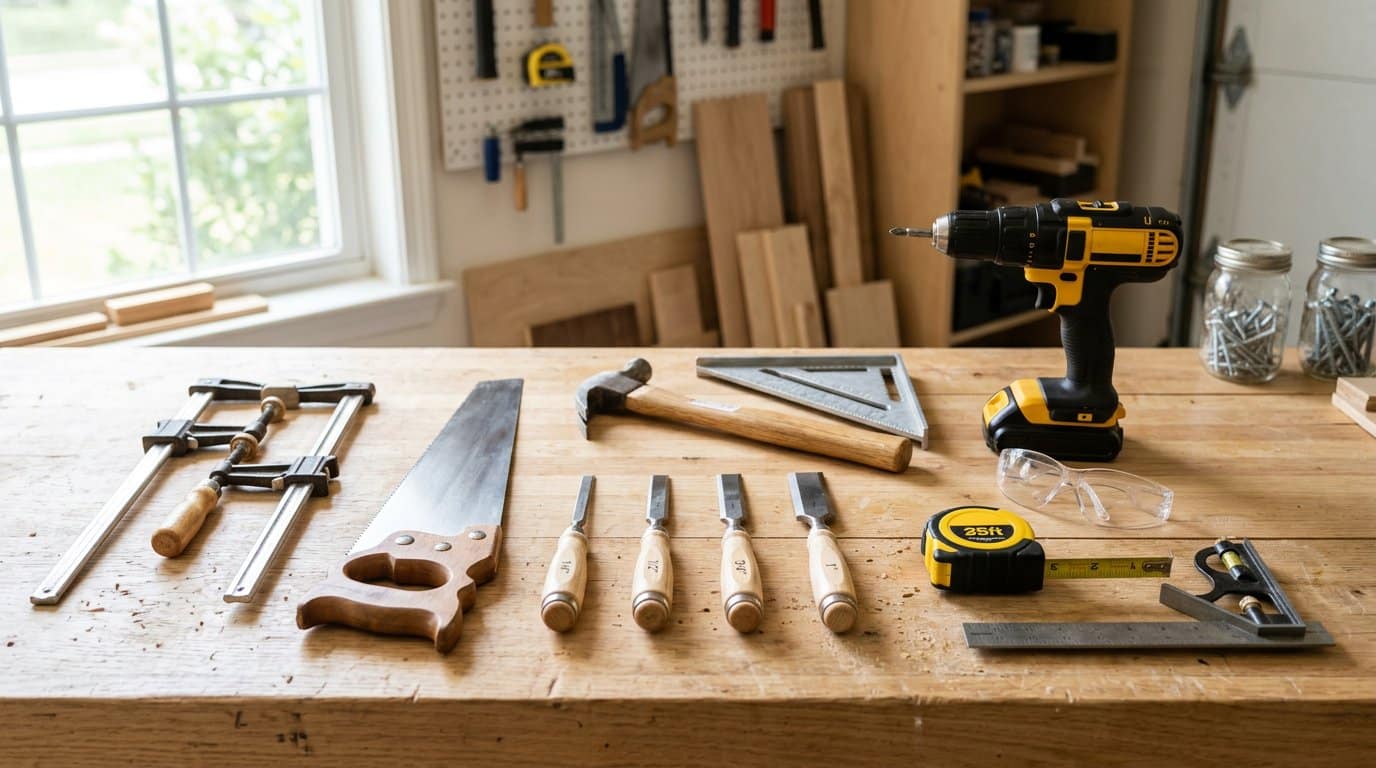
There is a drawer in my workshop I avoid opening. Inside it are a biscuit joiner I have used once, a set of specialty plane blades still in their oiled paper, a dowelling jig that seemed essential at the time and two gadgets whose purpose I can no longer explain. All of it was bought in the first enthusiastic month, before I had built anything. The tools that actually built every project on this site — the shelves, the planters, the river table, the gift boxes — are a much shorter list, and almost none of them came from that drawer.
If you are starting out, the risk is not having too few tools. It is buying too many, too early, in a kit, before you know what you like building. This guide is the list I wish I had been given: the twelve tools that earn their place immediately, the work surface that makes them usable, the five worth buying next, the five to ignore for now, and a realistic look at what a starter kit costs.
Buy tools the way you buy ingredients: per project
The single most useful rule for a beginner is this: buy the tool when a project needs it, not before. Woodworking has an endless catalogue of specialised gear, and every one of those tools genuinely makes sense — for someone building the thing it was designed for. A beginner buying ahead of their projects ends up with a workshop full of solutions to problems they do not have yet.
So the sequence looks like this. Choose a first project. Buy the few tools it requires. Build it. The next project will tell you, very clearly, which tool is missing. Repeat. Twelve months of that will leave you with a small, sharp, well-chosen kit — and money left over for good timber.
Two corollaries follow from it. First, buy the cheapest version that will do the job on anything you are not sure you will use often; you can always upgrade a tool you have worn out, and that upgrade will be informed by real use. Second, when you do know a tool is central to how you work — a drill, a sander, a saw you reach for every session — buy the best one you can justify, because that is the tool you will live with for a decade.
The 12 tools that earn their place
Everything below is a tool that will be used on almost any beginner project. Prices are rough typical ranges in US dollars and vary widely by brand, country and sale — treat them as order-of-magnitude, not quotes.
1. Tape measure (25 ft / 7.5 m)
The one tool you will use on every single project, so buy a decent one with a readable blade, a solid hook and a lock that holds. Learn the habit now: measure twice, cut once — and measure from the same reference edge every time, not from whichever end is nearest.
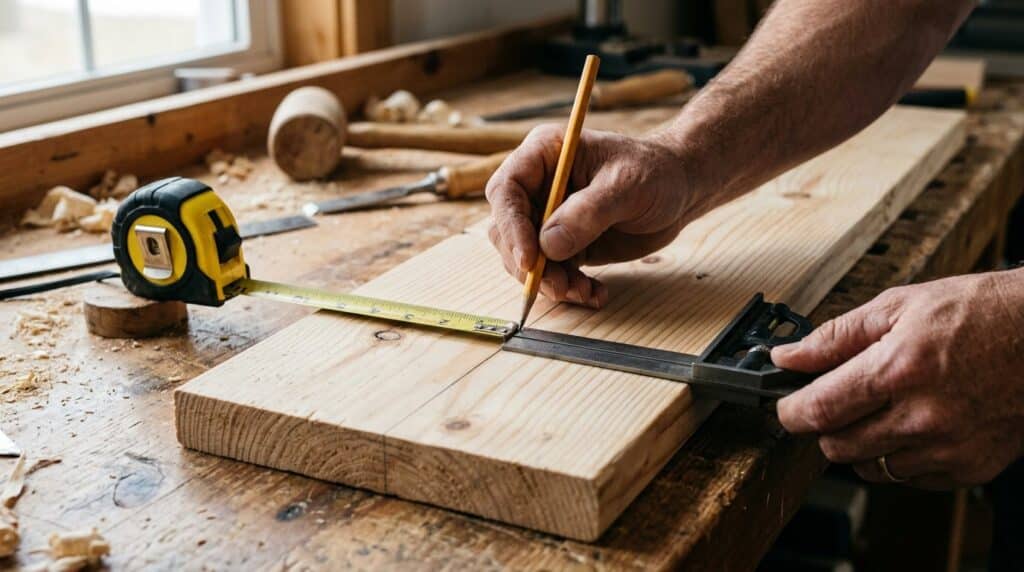
2. Marking tools: combination square, pencil, marking knife
A combination square does three jobs — marking 90° and 45° lines, checking that an edge really is square, and setting depths — and it does them accurately enough that you will keep using it long after you own fancier squares. Pair it with a sharp pencil or a mechanical pencil for layout, and a marking knife when you need a line accurate to a fraction of a millimetre (a knife line also severs wood fibres, which gives you a cleaner edge when you chisel or saw to it).
3. A Japanese pull saw (ryoba)
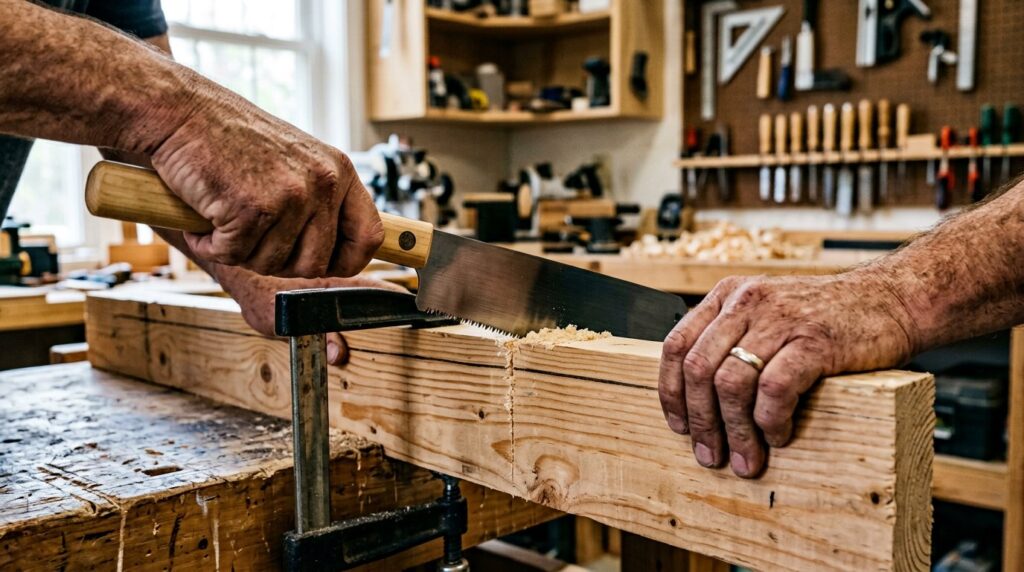
If you own one saw, make it a ryoba. It cuts on the pull stroke, which means the blade can be thin, the kerf narrow, and the cut remarkably accurate with very little effort — and it does not need the brute force a Western push saw does to track straight. A double-edged ryoba gives you a crosscut teeth on one side and rip teeth on the other in one tool. It is also quiet, cheap, and the safest first saw you can own.
4. Clamps — more than you think you need
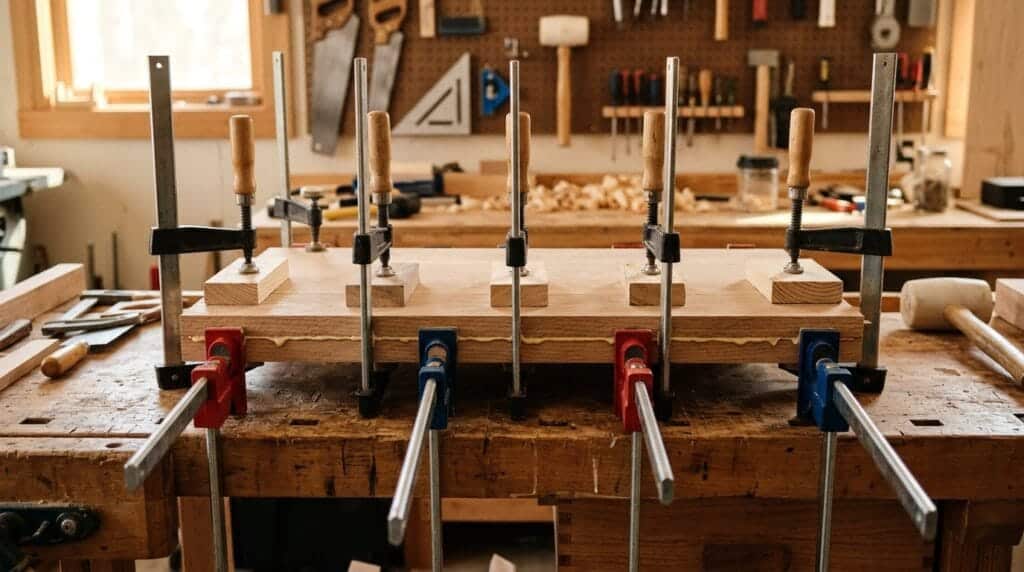
The standard joke is that you can never have too many clamps, and it is funny because it is true. Glue-ups need pressure spread evenly, and panels need to be held flat while they dry. Start with four 12-inch bar clamps or F-clamps and a pair of quick-grip one-handed clamps for holding work in place. Use cauls — straight offcuts — between the clamp and your workpiece so the pressure spreads and does not dent the wood.
5. Cordless drill/driver and a bit set
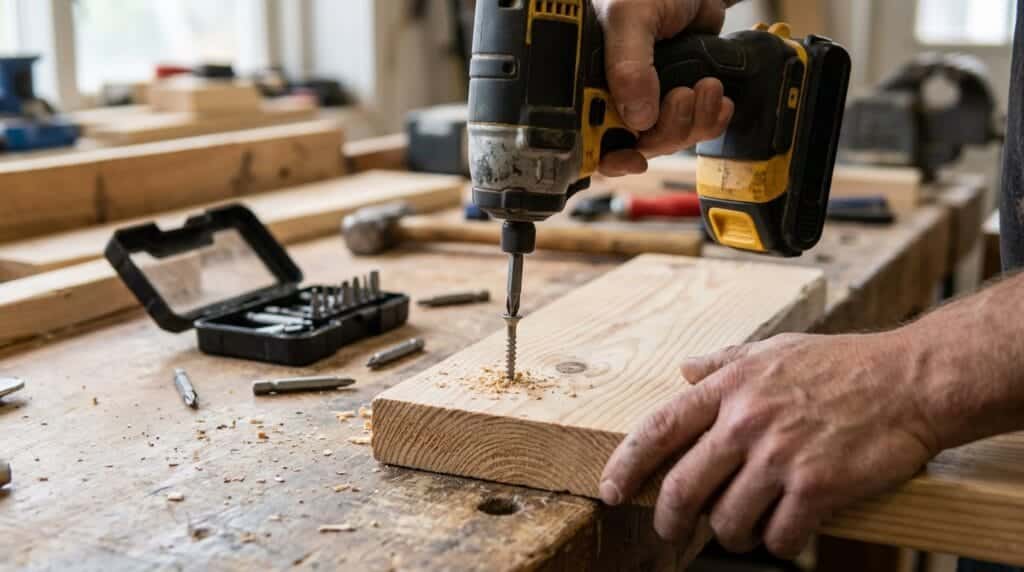
The first power tool most beginners should own. It drills holes, drives screws, and with the right attachments can sand, mix and countersink. Buy an 18V or 20V model from a brand whose battery platform you can grow into, because you will be buying more tools on that same battery later. Essentials alongside it: a good bit set, a few brad-point or twist bits for wood, and a countersink bit so screw heads sit flush instead of tearing fibres.
6. Random orbital sander
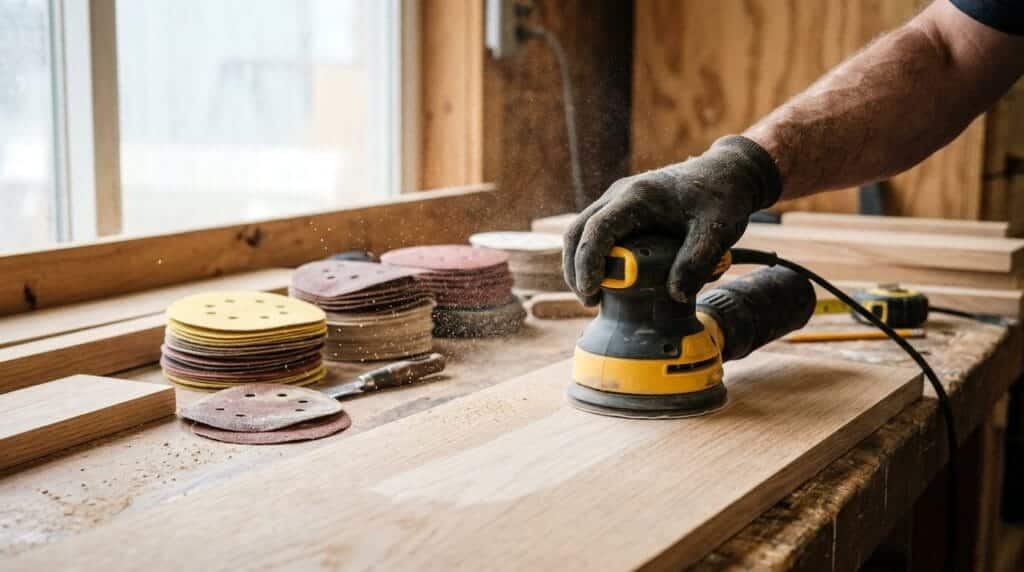
Hand-sanding a tabletop is a character-building experience you can skip. A 5-inch random orbital sander orbits and spins at the same time, which removes material fast without leaving the swirl marks a standard orbital sander would. Stock discs in 80, 120, 180 and 220 grit and work through them in order — jumping grits is the most common reason a “smooth” surface still looks scratched under finish. It pairs directly with the process in my sanding and finishing guide.
7. Chisels and a mallet
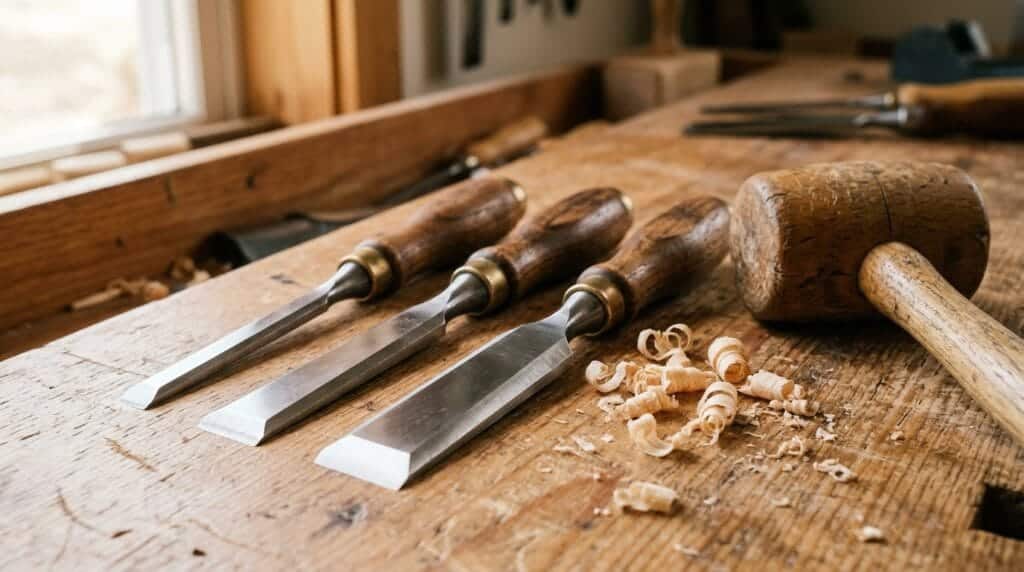
Three chisels — 1/4 inch, 1/2 inch and 3/4 inch — will handle almost every beginner task: cleaning out a hinge recess, paring a joint to fit, trimming a tenon. You do not need an eight-piece set. You do need them sharp: a blunt chisel is more dangerous than a sharp one because it requires force, and force is what slips. Add a wooden or rubber mallet so you never strike a chisel handle with a steel hammer.
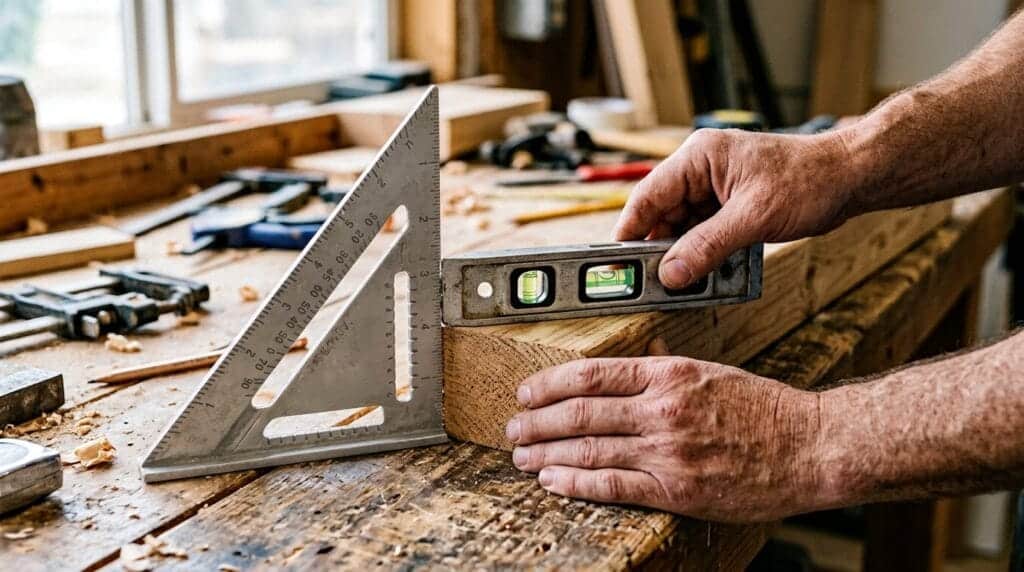
8. Speed square
A few dollars for a triangle that does an astonishing amount: marking square lines across a board, finding 45° angles, setting saw depth, checking a blade is square to its sole, and acting as a straightedge guide for a circular saw when you eventually own one. There are two common sizes — 7 inch for general work, 12 inch for framing and larger stock.
9. Spirit level (and a small torpedo level)
Shelves, wall-mounted pieces, planter boxes and anything with a door need to be level, and the eye is unreliable at judging it. A 24-inch level covers most furniture and shelving; a short torpedo level is handy for tight spaces. Check any level before trusting it: place it on a surface, read it, then flip it end for end — if the bubble sits differently, the level is out.
10. Claw hammer
Still the fastest way to tap a joint together, set a nail, persuade a stubborn piece into place, and — with a scrap block protecting the wood — knock things apart again. A 16 oz curved-claw hammer is the general-purpose size. Keep the face clean; a greasy hammer face slides off nail heads and marks your workpiece.
11. Utility knife
Not glamorous, used constantly: opening material packaging, trimming veneer and edge banding, scoring a line before a cut to prevent tear-out, sharpening a pencil, cutting cord and tape. Buy one with a retractable blade and spare blades, and change blades more often than feels necessary — a dull blade tears instead of cutting.
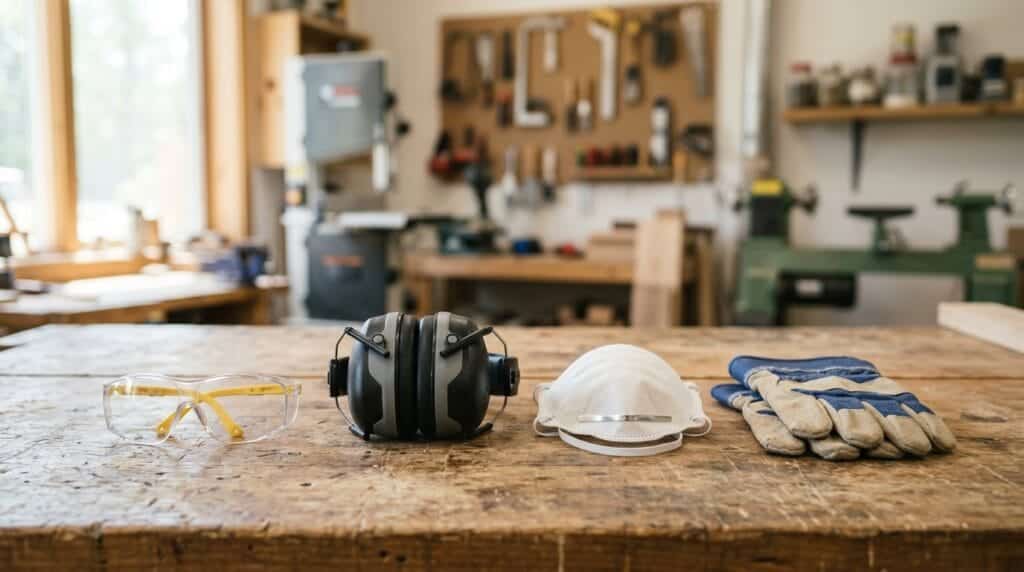
12. Safety gear
The only item on this list that is not optional. Safety glasses whenever anything is being cut, drilled or struck. Hearing protection for any power tool — the damage from repeated exposure is permanent and, annoyingly, painless at the time. A well-fitted dust mask or respirator whenever you sand or sweep up fine dust. Add push sticks and hearing-aware habits around any saw. None of this is dramatic; it is simply how people are still woodworking comfortably at seventy.
Where you work: sawhorses, a bench and light
Tools matter less than you think if you have nowhere to use them. A pair of sawhorses with a plywood top gives you a flat, stable, clampable surface for a fraction of the cost of a bench, and it can be folded away in a garage. What you need from any work surface: it must not rock, it must be at a height where you can press down with your forearm parallel to the floor, and you must be able to clamp work to it.
Lighting is the upgrade beginners never budget for and always notice. A portable work light aimed across the surface — not from directly behind you, which casts your own shadow — makes layout lines visible and cuts safer.
The next five tools to buy (when a project asks for them)
Not now — but soon, and in roughly this order as your projects grow:
- Jigsaw — the first saw most people should buy after a handsaw. Curves, cut-outs, sink holes, and rough breakdown of sheet goods.
- Circular saw — straight, fast cuts in sheet material and long boards. With a straightedge guide it replaces a table saw for a lot of beginner work.
- Pocket-hole jig — the fastest route to strong, simple frames and carcasses without traditional joinery. Genuinely transformational for beginner furniture.
- Mitre saw — repeatable, accurate crosscuts and angles. Buy it when you start making frames, trim or anything with many identical cut lengths.
- Router — the most versatile tool in the shop and the steepest learning curve: round-overs, grooves, flush trimming, joints.
Five tools you don’t need yet
Skipping these is not deprivation; it is sequencing. Each is excellent at what it does, and none of it matters until you are building at a scale or volume that demands it:
- Table saw — the heart of a serious shop, but expensive, space-hungry and demanding of respect. A circular saw with a guide covers most early needs.
- Thickness planer — only makes sense once you are buying rough-sawn timber in quantity.
- Biscuit joiner or Domino — solves alignment problems that pocket screws and glue solve well enough at beginner scale.
- Large “all-in-one” combo kits — the classic beginner trap: fifty pieces, of which you will properly use six.
- Wood lathe — a whole discipline of its own. Wonderful, later, if turning is what pulls you in.
What a realistic starter kit costs
Assuming you start from nothing, here is the order of magnitude in US dollars. Prices shift constantly by brand and region — these are broad ranges, not quotes:
| Tier | What you get | Typical total | Who it suits |
|---|---|---|---|
| Budget | Store-brand hand tools, one own-brand drill, basic sander, four clamps | roughly $150–$300 | Testing whether woodworking is for you |
| Sensible | Decent hand tools + mid-range cordless drill and sander, good square, six clamps | roughly $400–$700 | Most beginners — buy this |
| Buy-once | Premium hand tools, pro-grade drill and sander, cabinet-grade square | $900+ | You already know you are hooked |
Two things are worth more than the tier you pick: wood costs more than you budget, and one excellent chisel beats a set of mediocre ones. If money is tight, buy fewer tools at a higher quality rather than more tools at a lower one — with the exception of clamps, where quantity genuinely is the feature.
New, used or borrowed
Buy new: anything with a motor or a battery (drills, sanders, saws), measuring tools, and safety gear. Batteries and warranties matter, and a square that is out of true is worse than no square at all.
Buy used: hand planes, chisels, clamps, hand saws, and cast-iron machinery. Old hand tools are frequently better than new ones at the same price, and a rusty plane is a half-hour restoration, not a write-off. Check that wood-handled tools are not loose or cracked and that soles are flat.
Borrow or hire: anything you need exactly once — a tile saw to cut a backsplash for a shelf unit, a floor sander, a specialised jig. Ask before you buy.
Looking after what you own
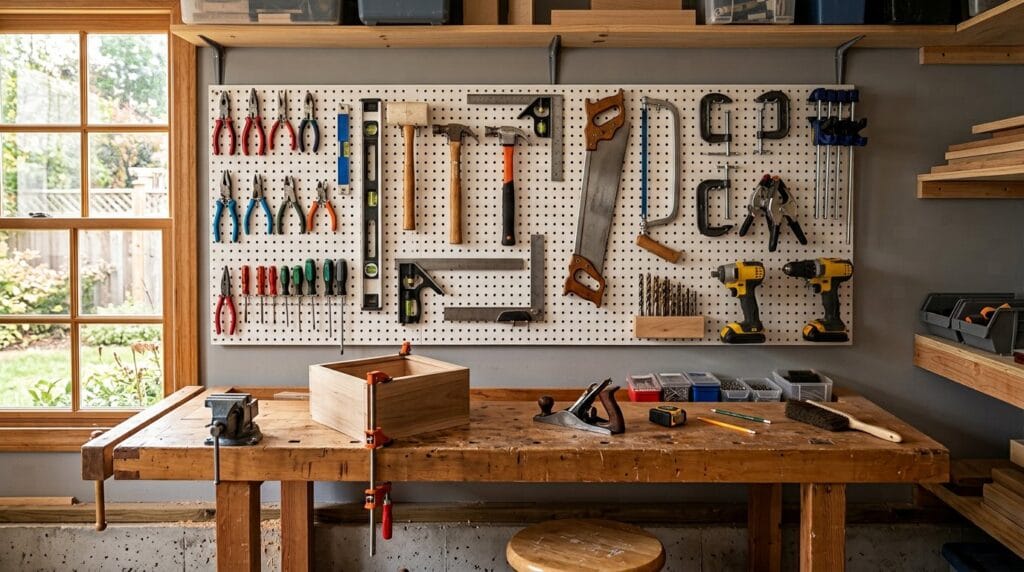
Tools fail from neglect far more often than from use. Keep them dry — a garage that rusts cast iron will also rust your chisels; a light wipe of paste wax on cast-iron tables and a camellia-oil wipe on steel hand tools prevents it. Store batteries at room temperature and partly charged, not flat in a freezing shed. Keep cutting edges sharp: a blunt chisel or plane iron makes every job harder and every result worse. And give everything a home — a pegboard, a toolbox, a shelf — because a tool you cannot find is a tool you will re-buy.
Common questions
Do I need a table saw to start woodworking?
No. A Japanese pull saw for small work, plus a circular saw with a straightedge guide for sheet goods and long boards, covers almost everything a beginner builds. Buy a table saw when you find yourself doing the same cut often enough to justify the space, the cost and the safety discipline.
What is the single most important tool for a beginner?
Accuracy comes before everything, so it is the combination square and tape measure together. A perfectly cut joint in the wrong place is scrap; the same joint marked correctly is a project that fits. After that, a sharp chisel and a drill.
How many clamps is enough?
A practical starting point is six: four bar or F-clamps long enough for the panels you build, and two quick-grips for holding work steady while you drill or mark. You will buy more the first time a glue-up needs eight.
Are cheap tools worth buying?
Sometimes. Squares, hammers, speed squares, utility knives and clamps are fine at modest prices. Things that spin, cut or measure precisely — drills, sanders, saw blades, measuring tools — are where the extra money shows up in every result. The pattern that works: buy cheap first, and upgrade the specific tool you wear out.
What should I build first with these tools?
Something small, square and useful — a shelf, a box, a step stool, a planter. Each teaches squaring, cutting, drilling and finishing without demanding joinery you have not learned yet. My roundup of scrap wood projects is designed for exactly that first weekend, and the plans guide shows how to turn any project into a cut list before you make the first saw cut.
Everything above comes from a workshop built one project at a time — including that drawer of regret. If a tool has earned a place here, it is because it survived a year of regular use rather than a month of enthusiasm. Wear eye and ear protection, keep your dust extraction or a mask on hand, and read the manual before any power tool’s first cut. Spotted something wrong, or a tool you would add to the twelve? Tell me here and I will update the list.
Ready to put the kit to work?
A tool kit only becomes useful when it cuts something. Start with a small project that uses the whole list — measure, mark, saw, drill, glue, clamp, sand — because those seven actions are 90% of every project you will ever build. My scrap wood projects cost almost nothing in timber, the beginner plans guide will turn your idea into a cut list, the sanding and finishing guide makes the result look shop-bought, and the guide to preventing warping and cracking keeps it that way. When you are ready for a bigger challenge, the epoxy river table build is the most rewarding weekend I have written up — and the easy furniture projects roundup has ten more pieces waiting.