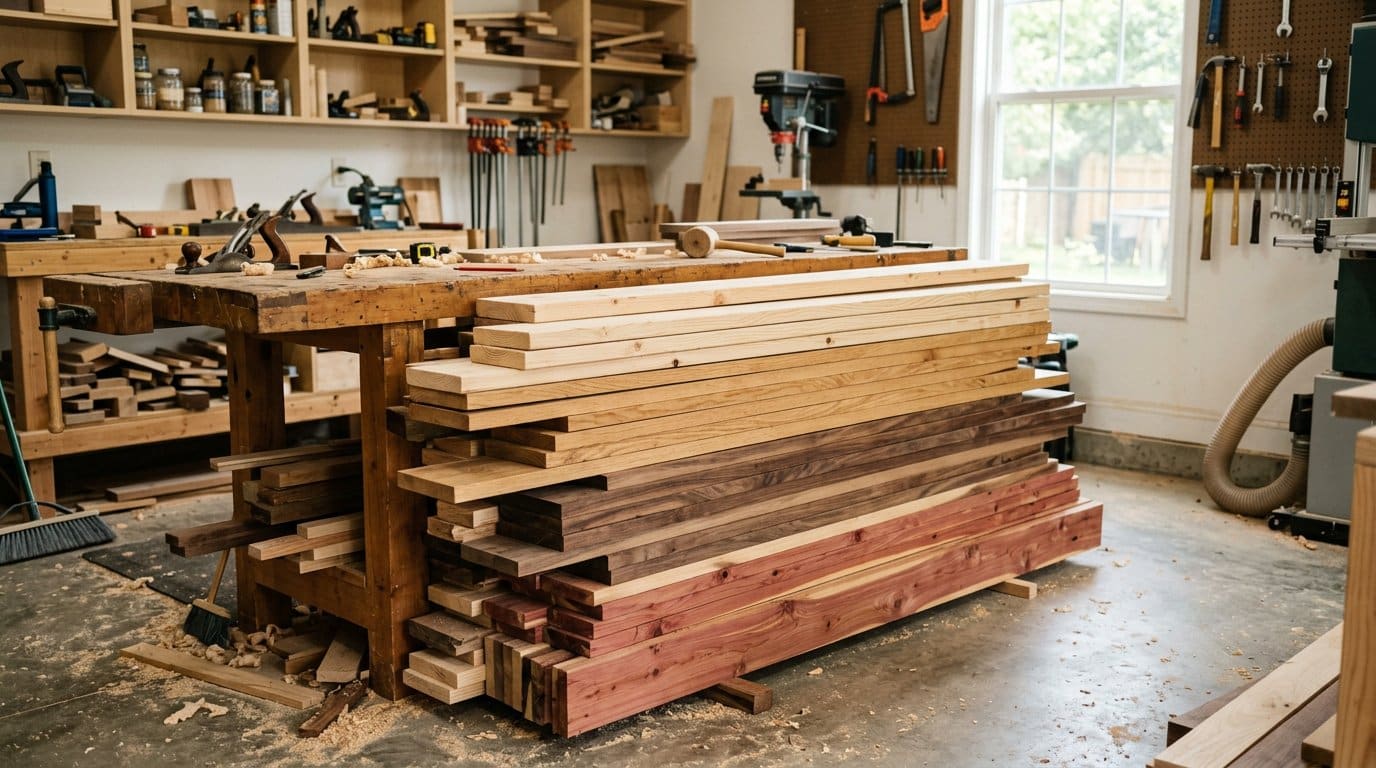
Every beginner woodworking mistake I see traces back to the same moment: standing in the lumber aisle, staring at a wall of boards, unable to tell why one costs three times the other. The wood you choose decides how your project looks, how it behaves in the humidity swings of a real home, how long it takes to sand, and how much it costs before you make a single cut. This guide is the conversation I wish someone had given me on day one — what each common species is actually good at, how to read a lumber tag, what things really cost in 2026, and how to match the wood to the job instead of buying whatever is closest.
Quick answer: for your first furniture projects, buy poplar or red oak for anything painted or hidden, hard maple for anything that gets handled daily, and pine for practice pieces and shelves. Save walnut, cherry and white oak for the project you are proud of. Buy rough lumber from a yard, not surfaced boards from a home center, and you will pay a third of the price for better wood.
Softwood vs hardwood: the difference that actually matters
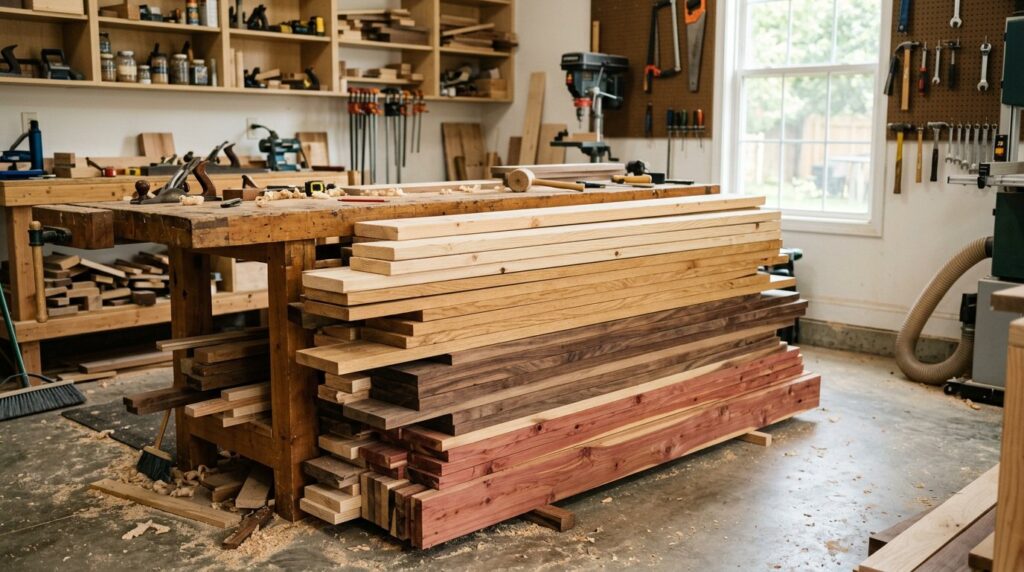
Walk into any lumber yard and the first fork in the road is softwood or hardwood. Botanically, softwoods come from conifers (pine, cedar, fir, spruce) and hardwoods from broadleaf trees (oak, maple, walnut, cherry). In the shop, the difference that matters is practical:
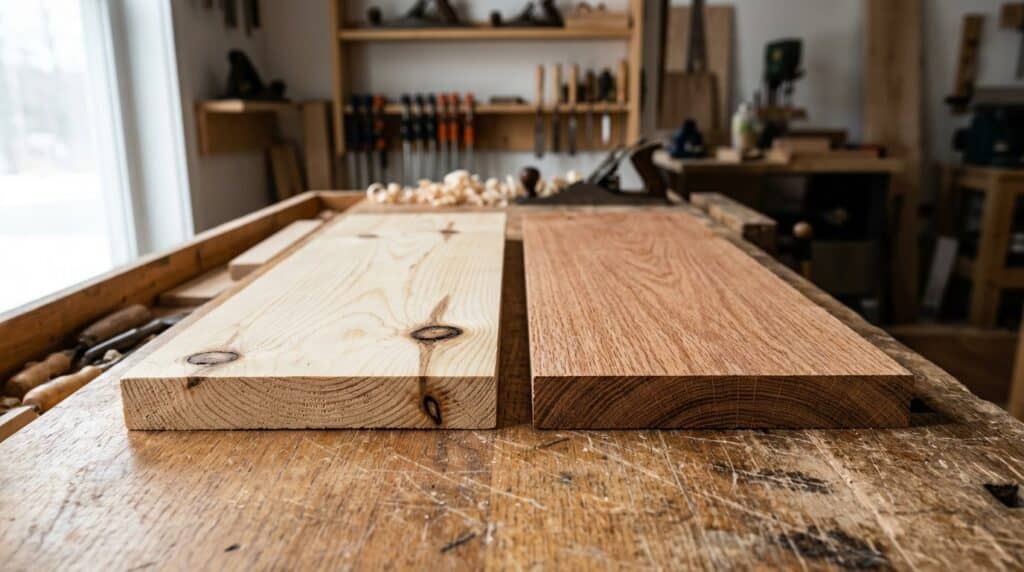
- Softwoods are lighter, softer, cheaper and easier to cut, screw and sand. They dent and scratch easily, which is why you rarely see them in fine furniture — but they are ideal for shelves, shop jigs, practice joints, painted pieces and outdoor structures.
- Hardwoods are denser, harder, more stable and far more dent-resistant. They cost more and they punish dull blades, but they take a crisp edge, hold a screw without splitting, accept a fine finish, and look like furniture for decades.
The beginner trap is assuming hardwood is always “better.” It is not — it is better for specific jobs. A pine bookcase painted white is a perfectly good bookcase. A walnut bookshelf you cannot afford is not.
The species cheat sheet: what each common wood is actually for
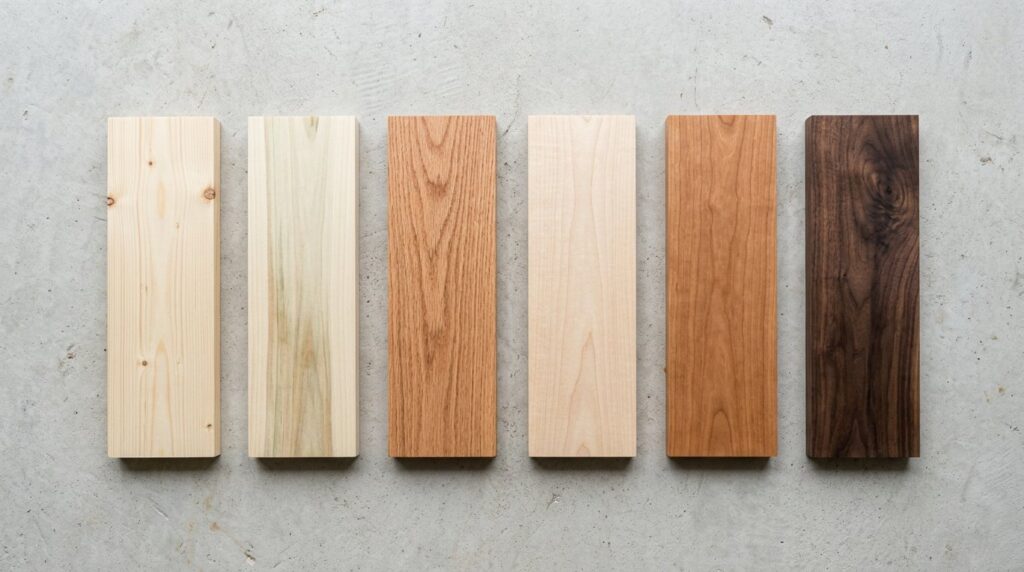
You do not need to memorise forty species. Six softwoods and eight hardwoods cover 95% of home woodworking. Here is the cheat sheet I keep taped inside my shop cabinet.
Softwoods
- Pine (Eastern white) — pale, soft, full of knots, the cheapest real wood you can buy. Perfect for shop furniture, jigs, practice cuts and painted shelves. Avoid for tabletops that take abuse.
- Southern yellow pine — denser and harder than white pine with a warm honey tone and bold grain. The classic choice for workbenches, shop cabinets and rustic furniture. Hard on blades; pre-drill every screw.
- Cedar (Western red) — aromatic, naturally rot- and insect-resistant, lightweight. The default for outdoor furniture, planter boxes, closet lining and chests. Do not use indoors where you want a hard wearing surface.
- Fir (Douglas) — strong for its weight, straight-grained, the backbone of construction framing. Fine for shop builds and painted utility pieces; the splinters are miserable on bare hands.
- Pressure-treated pine — ordinary pine infused with preservative. Required for anything touching ground or standing water outdoors. Never burn it, never use it indoors, and let it dry before painting.
- Redwood / cypress — premium outdoor softwoods, naturally durable and beautiful, but pricey and increasingly scarce. Worth it for a bench or pergola you want to last twenty years.
Hardwoods
- Poplar — the secret weapon of painted furniture. Cheap, stable, easy to machine, takes paint beautifully. It is technically a hardwood but behaves like a soft one. Greenish streaks in the grain are normal and disappear under paint.
- Red oak — the most available hardwood in North America. Strong, open-pored, takes stain evenly (sometimes too evenly — it can go blotchy), and priced reasonably. A red oak table is a lifetime table.
- White oak — like red oak but water-resistant and rot-resistant, which is why it is the traditional barrel and boat wood. Quarter-sawn white oak shows the famous ray-fleck figure. Costs more than red oak.
- Hard maple — pale, extremely hard, fine even grain. The professional choice for cutting boards, workbenches, butcher blocks and floors. Takes a clear finish beautifully; stains can look muddy, so dye or clear is the way.
- Cherry — the wood that improves with age. Starts pinkish-tan, deepens to a rich reddish-brown in sunlight over months. Machines like a dream. Expensive, so it rewards careful work — not the species for a first project.
- Walnut — dark, rich, stable, and the most forgiving premium wood to work. Fine furniture, gunstocks, accent pieces. The price is real: roughly two to four times red oak per board foot.
- Ash — tough and springy, pale with a grain like oak. Traditional tool handles and baseball bats. Beautiful, but supply has collapsed because of the emerald ash borer, so expect scarcity and rising prices.
- Hickory / pecan — the hardest domestic hardwood, shock-resistant, dramatic grain. Tool handles, flooring, rustic furniture. Punishing on blades and hard to stain evenly.
Match the wood to the job: a decision table
Price only makes sense next to a project. This table is the one I wish I had when I over-bought walnut for a garage shelf.
| Project | Best species | Why | Avoid |
|---|---|---|---|
| Painted bookshelf / cabinet | Poplar, pine | Cheap, stable, paint hides everything | Walnut, cherry (waste of money) |
| Dining table (daily use) | Red oak, hard maple, walnut | Dent-resistant, hard-wearing, takes refinishing | Pine (dents and scratches fast) |
| Cutting board / butcher block | Hard maple, walnut, cherry | Hard, tight grain, food-safe when finished right | Red oak (open pores trap food) |
| Workbench / shop furniture | Southern yellow pine, Douglas fir | Cheap, replaceable, tough enough | Anything expensive |
| Outdoor bench / planter box | Cedar, pressure-treated pine, white oak | Rot resistance is the whole job | Interior hardwoods (they rot) |
| Practice joints / first cuts | Pine, poplar | Cheap enough to ruin without crying | Your good stock |
| Picture frames / small gifts | Cherry, walnut, maple offcuts | Small quantities, so premium is affordable | — |
| Bathroom shelf / bath caddy | Cedar, teak, sealed white oak | Moisture is the enemy; these laugh at it | Pine, poplar (swell and mould) |
| Kids’ furniture / toys | Maple, birch, beech | Hard, splinter-resistant, non-toxic finishes | Pressure-treated anything |
| Accent wall / headboard | Pine, poplar, reclaimed boards | Large area, low wear, cost matters | Wide clear walnut (very expensive) |
If you take one rule from this table: never buy premium wood for a painted or hidden part, and never buy softwood for a surface that gets daily abuse. Everything else is optimisation.
How to read a lumber tag (and what the numbers mean)
Every board in a real lumber yard carries information; every board at a home center is trying to hide it. Learn to read four things and you will instantly buy better wood for less.
- Thickness in quarters — hardwood is sold in “quarters”: 4/4 means 1 inch rough, 5/4 is 1.25 inch, 8/4 is 2 inch. After surfacing (planing), 4/4 becomes about 13/16″ (roughly ¾”), 8/4 becomes about 1¾”. Buy one quarter thicker than your finished dimension.
- Rough vs S2S vs S4S — Rough (RGH) is straight from the saw, cheapest, needs a planer. S2S is surfaced on two faces. S4S is surfaced on all four sides, ready to cut, and priced accordingly. Home centers sell almost exclusively S4S.
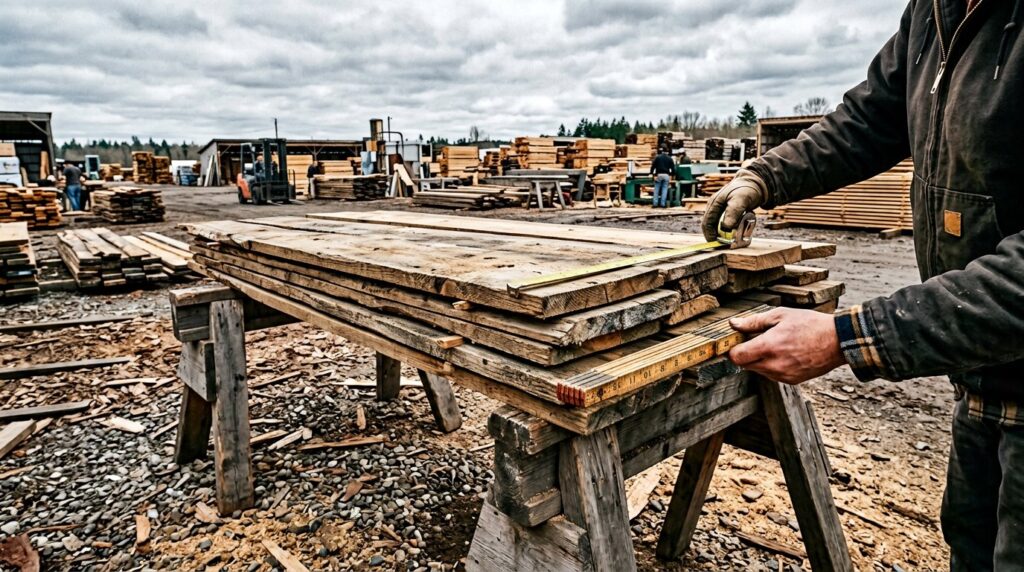
- Grade — hardwoods use the NHLA grades: FAS (Firsts and Seconds — the best, mostly clear), Select, #1 Common, #2 Common. Lower grades have more knots, mineral streaks and sapwood — cheaper, and often perfectly fine for rustic or painted work.
- Kiln-dried vs air-dried — kiln-dried (KD) is stable and ready to work, and costs more. Air-dried (AD) is cheaper but can still move. Green lumber is for turning or outdoor use only — it will warp as it dries.
- Board feet (BF) — the volume unit: board feet = (thickness in inches × width in inches × length in feet) ÷ 12. A 1″ × 6″ × 8′ board is 4 board feet. Lumber yards price per board foot; home centers price per board, which hides the maths.
Reading NHLA grades without the anxiety
Grades measure clear cutting yield — how much defect-free wood a board produces — not beauty. A #1 Common board with character can be more interesting than a clear FAS board, and for painted or rustic work it is simply cheaper. FAS is for panels you will see and admire. #1 Common is for everything else. The only grade to avoid as a beginner is whatever the yard is embarrassed to stamp.
What wood actually costs in 2026
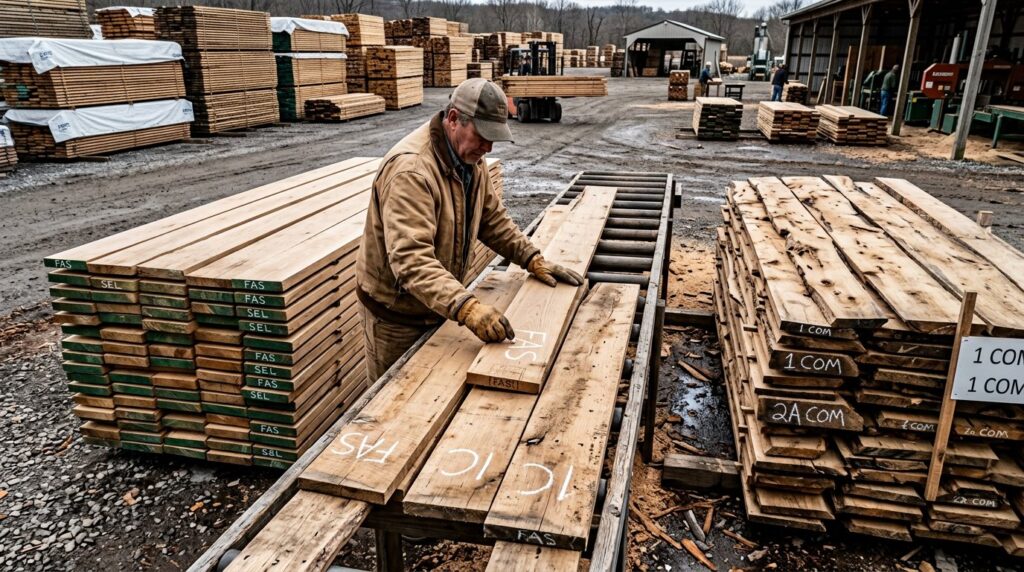
Prices move with region, grade, thickness and supplier, but these are realistic 2026 ranges for rough, kiln-dried hardwood at a US lumber yard, and the comparison that should change how you shop:
| Species | Rough, per board foot | Surfaced (S4S), per board foot | Reality check |
|---|---|---|---|
| Eastern white pine | $2.50 – $4.00 | $4 – $7 | Cheapest real wood; home centers charge near hardwood prices for clear pine |
| Southern yellow pine | $2.75 – $4.50 | — | Usually sold as construction lumber; excellent value per pound of strength |
| Western red cedar | $4.50 – $7.00 | $6 – $10 | Pricey for a softwood — you are paying for rot resistance |
| Poplar | $3.50 – $6.50 | $5 – $8 | The cheapest paint-grade hardwood; the value king |
| Red oak | $4.50 – $8.50 | $8 – $12 | The workhorse; a 40 BF table top runs roughly $200–$340 rough |
| Soft maple | $5.00 – $7.50 | $7 – $10 | Looks like hard maple, machines easier, takes paint better |
| Hard maple | $7.00 – $10.00 | $10 – $14 | Worth every dollar for anything handled daily |
| White oak | $7.00 – $11.00 | $10 – $15 | Quarter-sawn figured stock runs $12–$20 per board foot |
| Cherry | $6.00 – $9.00 | $9 – $14 | Prices keep climbing; buy early if a cherry piece is on your list |
| Ash | $6.00 – $8.50 | $8 – $12 | Scarcity from the emerald ash borer is pushing prices up |
| Black walnut | $10.00 – $18.00 | $14 – $22 | FAS wide clear stock: $18–$30+. Slabs for river tables: $20–$50+ |
| Ipe (imported) | $18.00 – $35.00 | — | Outdoor decking premium; dense enough to sink in water |
Why the home center charges two to three times more
A surfaced ¾” × 3½” × 6′ red oak board at a big-box store lists around $15. Its actual volume is about 1.3 board feet, which works out to roughly $11 per real board foot — against $4.50–$8 for rough red oak at a yard. You are paying for the planing, the pretty packaging, the convenience and the small, uniform sizes. None of that is free, and for a whole project the premium is brutal: a 40-board-foot table top that costs $200–$340 rough can cost $600+ in surfaced home-center boards.
The compromise that works for beginners: buy rough lumber from a yard and surface it yourself if you own (or can borrow) a planer, or buy S2S surfaced stock from an online hardwood dealer — you pay a modest premium over rough and skip the dust. Home-center S4S is the right choice only for a single small board when you need it today.
How to budget lumber for a project (with the waste factor)
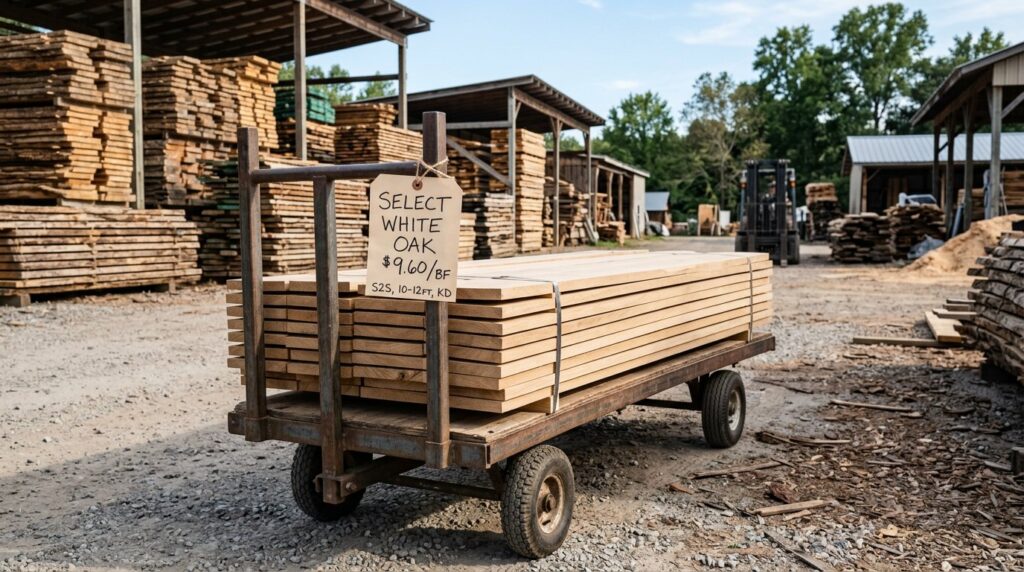
Every plan underestimates wood, because every project produces mistakes, test cuts and offcuts. The professional habit: calculate your board feet, then add 20–30%. For a first attempt at a new joint or species, add 50%. A board you do not need is a scrap-bin investment; a board you need and do not have costs a second trip, a second milling fee and a mismatched colour batch.
Worked example: a small bookshelf needs four shelves of ¾” × 10″ × 36″ and two sides of ¾” × 10″ × 60″. That is 10 + 5 = 15 board feet of finished dimension. In 4/4 rough stock (1″ thick), the same parts need about 20 board feet. Add 25% waste → buy 25 board feet. At $6 per board foot for red oak, the wood costs about $150. At home-center S4S prices, the same shelves run $300+. The species and the supplier decide the bill more than the design does.
Pine vs oak vs maple vs walnut: the four-way showdown
If you only ever learn four species, learn these. They cover almost every home woodworking decision.
| Pine | Red oak | Hard maple | Walnut | |
|---|---|---|---|---|
| Cost (rough, per BF) | $2.50–4.00 | $4.50–8.50 | $7.00–10.00 | $10.00–18.00 |
| Hardness | Soft, dents easily | Hard, dent-resistant | Very hard, the toughest common choice | Hard, slightly softer than maple |
| Grain | Bold, knotty, rustic | Open, prominent, dramatic | Fine, subtle, even | Straight or wavy, rich and dark |
| Takes stain? | Blotchy — use gel stain or paint | Yes, evenly with a pre-stain conditioner | Poorly — use dye or a clear finish | rarely needs it — the wood is the finish |
| Best for | Practice, shelves, shop builds, paint | Tables, floors, cabinets, Craftsman furniture | Cutting boards, benches, fine painted or clear pieces | Fine furniture, accents, “forever” pieces |
| Beginner verdict | Learn on it | Best all-round first hardwood | Buy it for the piece you touch dailySave it for the piece you are proud of |
Outdoor wood: the species that survive weather
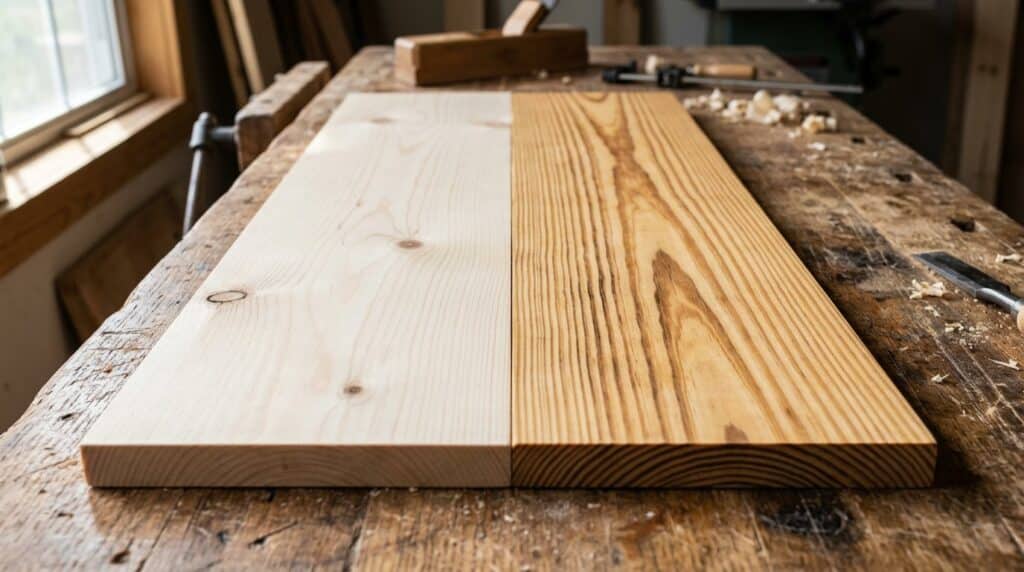
Indoor furniture wood rots outside. The species below are the ones that laugh at rain, sun and freeze-thaw cycles — and the finishes that protect everything else.
- Western red cedar — the default for planters, benches and siding. Naturally rot-resistant, lightweight, beautiful silver-grey patina if left unfinished. Cost is the trade-off.
- White oak — the traditional outdoor hardwood. Rot-resistant, strong, and it turns a dignified grey outdoors. Red oak rots fast outside — do not substitute it to save money.
- Black locust — arguably the most rot-resistant North American wood, extremely hard, and often overlooked. Fence posts of locust outlast pressure-treated pine. Splinter-prone when weathered; sand before it becomes seating.
- Pressure-treated pine — the budget outdoor answer. Modern treatments (ACQ, CA) are safe for planters with a liner and fine for furniture. Let it dry a few weeks before finishing; it arrives wet.
- Ipe, teak, white oak alternatives (ipe especially) — premium imported decking woods. Ipe is dense, hard and lasts 25+ years, but it eats blades and needs carbide. Teak is the marine gold standard and priced like it.
- Cypress and redwood — naturally durable softwoods, regionally available, beautiful — and increasingly expensive.
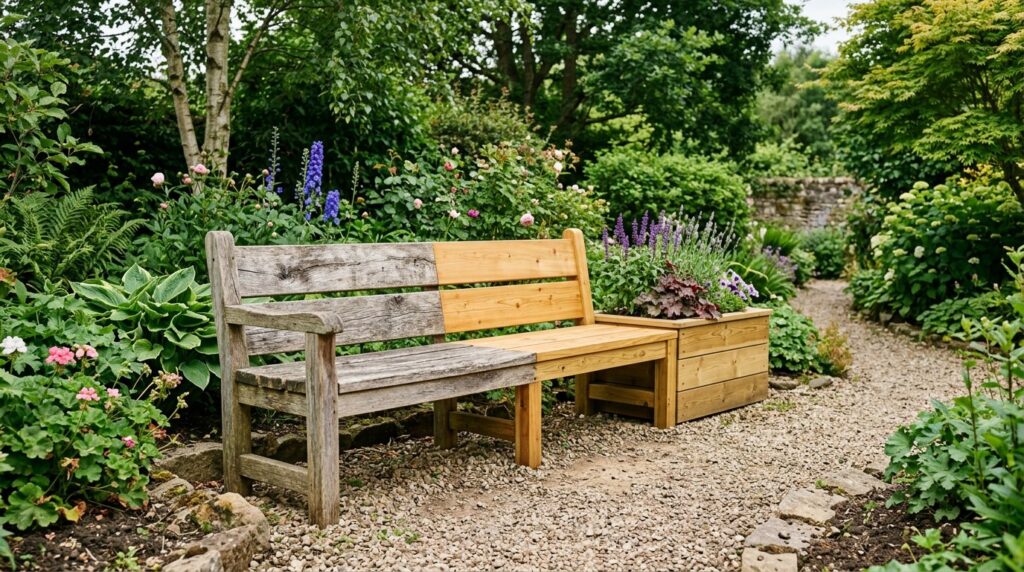
The finish matters as much as the species. A marine spar varnish or a penetrating outdoor oil on a cedar bench adds years; the same bench unfinished still survives, but it greys, checks and roughens faster. If you are building for the patio, read our outdoor furniture projects guide and our planter box ideas first — both lean heavily on cedar and pressure-treated pine for good reason.
Stain, paint or leave it natural?
Wood finishes are a whole topic, but the species decides your options before you buy a single can:
- Paint — hides everything. Poplar and pine are the cheap, stable substrates. Never paint walnut or cherry; you are hiding the reason you paid for them.
- Stain — shows grain, changes colour. Red oak and ash stain beautifully (with a pre-stain conditioner). Pine blotches — use a gel stain or a wood conditioner first. Maple stains unevenly — use dye instead. Walnut rarely needs stain at all.
- Clear finish (oil, varnish, lacquer) — the honest option. Lets the wood speak. Best on maple, cherry, walnut, oak and cedar. This is where premium wood earns its price.
- Nothing (outdoors) — cedar, redwood, cypress and teak are designed to weather to a silver patina. A finish only delays the inevitable and needs re-coating forever.
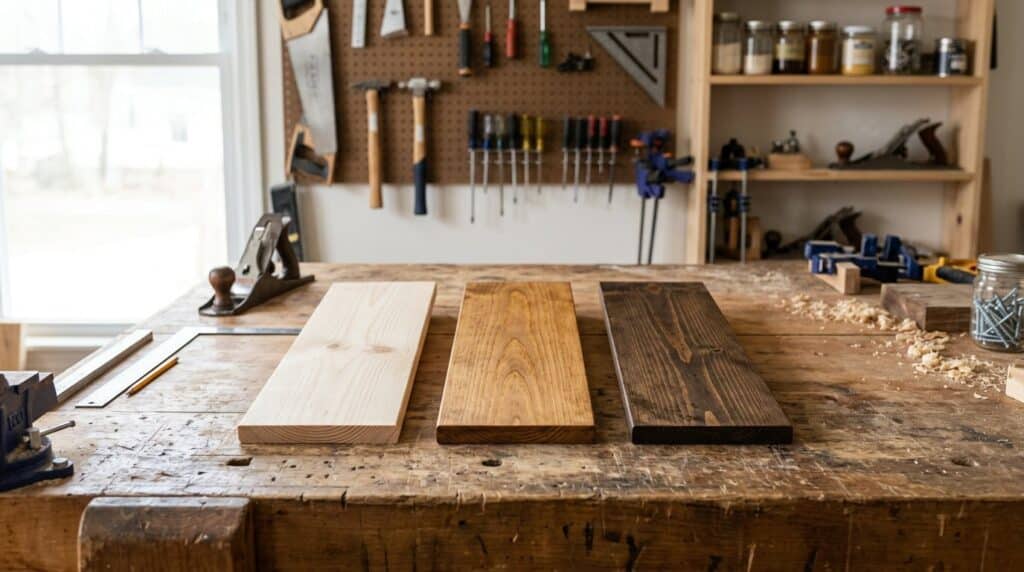
For the full process, our wood sanding and finishing guide walks through grits, stains and topcoats step by step — and pairs naturally with the species choices above.
Five beginner mistakes when buying wood (and how to avoid them)
- Buying the pretty board, not the right board. A figured walnut slab is gorgeous and useless for a painted cabinet. Match species to job first, beauty second.
- Buying S4S home-center boards for a whole project. You will pay two to three times the yard price. One board today is fine; a whole project is a donation to the home center.
- Ignoring moisture content. Wood that is still wet will warp, crack and open your joints as it dries — the number one cause of “my table twisted.” Buy kiln-dried, and let lumber acclimate indoors for a week or two before cutting. Our warping and cracking guide covers the details.
- Forgetting the waste factor. Calculate board feet, then add 20–30% (50% for a first attempt). A second trip mid-project is the most expensive lumber you will ever buy.
- Buying too little of a “look.” Colour and figure vary board to board. For a visible panel, buy all the boards from the same flitch (the same log), or accept a patchwork. This is the one mistake that no budget fixes afterwards.
What to buy first: a starter wood shopping list
If you are setting up a shop and want a first lumber order that teaches you without bankrupting you, this is it. Roughly 60–80 board feet total, around $250–$400 depending on your yard:
- 20 BF of pine (4/4 and 8/4) — practice joints, shop jigs, a first shelf. ~$60–$80.
- 20 BF of poplar — a painted bookcase or cabinet. The confidence builder. ~$80–$110.
- 20 BF of red oak — a real table top or bench. Your first “real” hardwood. ~$100–$170.
- 10–15 BF of hard maple — a cutting board or small work surface. Feels like a different material. ~$90–$150.
- A few boards of cedar or pressure-treated pine — one outdoor piece. ~$30–$60.
That order is deliberate: it moves from forgiving and cheap to demanding and premium, so each purchase teaches you something the previous one could not. By the time you are buying walnut, you will know exactly why you are paying for it.
New to the tools that will dimension all of this stock? Start with our woodworking tools for beginners guide — it covers the twelve tools (and the five you can skip) that turn a pile of rough lumber into a finished piece. And when you are ready to read a cut list and buy exactly the right amount, our woodworking plans guide shows how to go from drawing to shopping list without the guesswork.
FAQs
What is the cheapest wood for furniture?
Pine is the cheapest real wood, and poplar is the cheapest paint-grade hardwood. For painted furniture, poplar is the better buy — it is more stable, machines cleaner and takes paint without the knots bleeding through.
What is the best wood for a beginner’s first project?
Pine for practice, poplar for a painted piece, red oak for your first “real” furniture. Red oak is the classic first hardwood because it is affordable, widely available, forgiving of beginner mistakes and hard enough to feel like an achievement.
Is oak better than pine for furniture?
For a table or chair that will be used daily, yes — oak is harder, denser and far more dent-resistant. For a painted bookcase or a shop cabinet, pine is the smarter buy. “Better” depends entirely on the job.
Why is walnut so expensive?
Walnut trees grow slowly, are relatively scarce, and every board is beautiful — dark, stable, fine-grained. High demand from furniture makers against limited supply keeps prices at two to four times red oak per board foot. You are paying for scarcity and looks, not just strength.
Can you use pine for outdoor furniture?
Only if it is pressure-treated pine, and even then it needs a protective finish and will not last as long as cedar. Untreated pine outdoors rots within a couple of seasons. Cedar, white oak, locust and tropical hardwoods are the real outdoor choices.
What does S4S mean on a lumber tag?
“Surfaced four sides” — the board has been planed smooth on all four faces and is ready to cut. It is the most convenient and the most expensive way to buy. Rough lumber is cheapest but needs a planer; S2S (surfaced two sides) is the middle ground.
How do you calculate board feet?
Board feet = (thickness in inches × width in inches × length in feet) ÷ 12. A 1″ × 6″ × 8′ board is (1 × 6 × 8) ÷ 12 = 4 board feet. Multiply board feet by the price per board foot to get the cost. Always add 20–30% for waste and mistakes.
Does expensive wood make better furniture?
Expensive wood makes more beautiful furniture, and harder wood makes longer-lasting furniture — but a poorly designed joint in walnut fails just as fast as one in pine. Good design, good joints and the right species for the job beat an expensive species every time.